


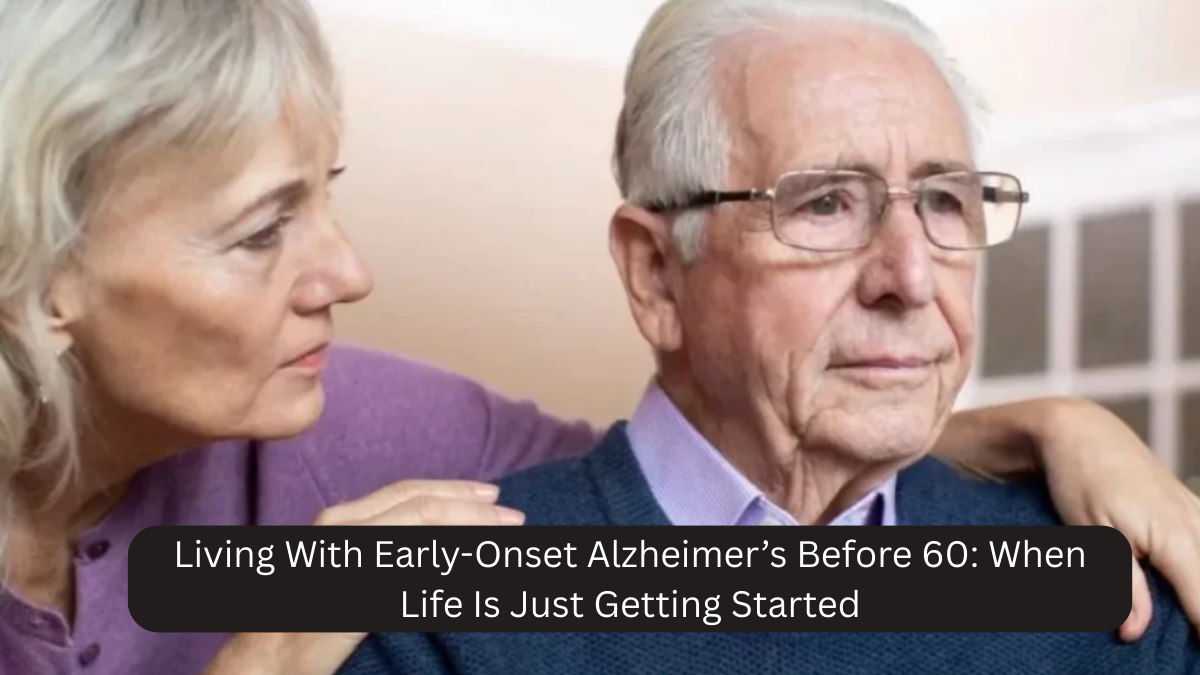
Alzheimer’s disease is often associated with old age, retirement, and the later stages of life. But for thousands of individuals around the world, Alzheimer’s arrives far earlier—sometimes in their 30s, 40s, or 50s—when careers are thriving, families are growing, children are still young, and life is still unfolding.
This is known as early-onset Alzheimer’s, also called young-onset Alzheimer’s, and it presents a uniquely devastating reality: receiving a progressive neurodegenerative diagnosis at a time when life is supposed to be expanding, not contracting.


Living with early-onset Alzheimer’s before 60 is not just a medical condition—it is a psychological, emotional, social, financial, and identity-altering experience that affects every aspect of a person’s life and the lives of everyone around them.
What Is Early-Onset Alzheimer’s?
Early-onset Alzheimer’s refers to Alzheimer’s disease that develops before the age of 65. It accounts for approximately 5–10% of all Alzheimer’s cases, yet its impact is disproportionately complex due to the stage of life it affects.
Unlike late-onset Alzheimer’s, early-onset cases often progress faster and are more difficult to diagnose because symptoms are frequently mistaken for stress, burnout, depression, anxiety, or midlife crisis.
Common Early Symptoms
- Memory loss that affects work performance
- Difficulty concentrating
- Trouble with planning and organization
- Word-finding difficulties
- Mood changes and irritability
- Anxiety and depression
- Personality changes
- Disorientation
- Poor judgment
- Confusion in familiar environments

Because these symptoms overlap with stress-related disorders, many individuals go undiagnosed for years.
When the Diagnosis Comes Too Early
A diagnosis before 60 often arrives during life’s most active phase:
- Raising children
- Building careers
- Paying mortgages
- Supporting aging parents
- Planning futures
- Building identities
- Developing long-term goals
Instead of planning for retirement, individuals must plan for progressive cognitive decline.

The emotional impact is profound:
- Grief for the future that will not happen as expected
- Loss of identity
- Fear of dependency
- Anxiety about family burden
- Financial uncertainty
- Loss of independence
- Social isolation
- Existential distress
This is not just losing memory—it is losing who you are becoming.
The Unique Psychological Impact
Loss of Identity
Work, relationships, hobbies, and achievements often define personal identity in midlife. Early-onset Alzheimer’s threatens all of these at once.
Anticipatory Grief
People grieve the life they were building, the goals they may never reach, and the memories they may never form.
Fear of Burdening Loved Ones
Many individuals experience guilt over becoming dependent on partners, children, and family members.
Emotional Isolation
Because Alzheimer’s is associated with old age, younger patients often feel invisible and misunderstood.
Family Life and Parenting Challenges
For parents with young children, early-onset Alzheimer’s creates heartbreaking complexities:
- Explaining the illness to children
- Watching children become caregivers
- Losing parental roles
- Emotional role reversal
- Fear of genetic risk
- Disrupted family stability
Children grow up not only with a sick parent—but with a parent who is slowly changing in personality, memory, and presence.
Career and Financial Consequences
Early-onset Alzheimer’s often forces premature career exit, resulting in:
- Loss of income
- Loss of insurance
- Loss of professional identity
- Early disability
- Financial instability
- Reduced retirement savings
- Increased care costs
- Legal and planning burdens
The financial strain often affects entire families, not just the diagnosed individual.
Social Stigma and Misunderstanding
Many people with early-onset Alzheimer’s face:
- Disbelief
- Minimization of symptoms
- Misdiagnosis
- Social withdrawal
- Loss of friendships
- Lack of age-appropriate support groups
- Isolation from peer communities
They are often “too young” to fit into traditional dementia care systems.
Medical Complexity of Early-Onset Alzheimer’s
Early-onset Alzheimer’s often presents differently than late-onset:
- Faster progression
- More cognitive impairment early
- Higher likelihood of genetic components
- Greater neurological impact
- Stronger impact on executive functioning
Some cases are linked to genetic mutations, but many are not.
Living with the Diagnosis
Living with early-onset Alzheimer’s requires a shift from future-building to present-centered living:
Key Adaptation Strategies
- Simplifying daily routines
- Creating memory supports
- Establishing structure
- Building care networks
- Legal planning
- Financial planning
- Emotional counseling
- Therapy and support groups
- Family education
- Long-term care planning
The focus becomes preserving dignity, quality of life, autonomy, and meaning for as long as possible.
The Role of Support Systems
Strong support systems are essential:
- Family caregivers
- Professional caregivers
- Neurologists
- Therapists
- Social workers
- Community organizations
- Alzheimer’s support networks
- Peer communities
- Advocacy groups
Isolation worsens disease progression. Connection slows decline and improves quality of life.
Finding Meaning After Diagnosis
Many individuals with early-onset Alzheimer’s report a shift in perspective:
- Living more mindfully
- Prioritizing relationships
- Redefining success
- Valuing presence over productivity
- Embracing small moments
- Letting go of societal expectations
- Finding purpose in advocacy
- Sharing their stories
- Helping others feel less alone
Life changes—but it does not lose meaning.
Hope in Research and Treatment
Research in early-onset Alzheimer’s is expanding:
- Early detection technologies
- Biomarker testing
- Genetic research
- Disease-modifying therapies
- Lifestyle intervention research
- Neuroplasticity studies
- Cognitive rehabilitation
- Brain health programs
While there is currently no cure, the future of Alzheimer’s care is evolving rapidly.
Frequently Asked Questions (FAQ)
What age is considered early-onset Alzheimer’s?
Any diagnosis before age 65.
How common is early-onset Alzheimer’s?
It affects about 5–10% of Alzheimer’s patients.
Is early-onset Alzheimer’s genetic?
Some cases are genetic, but many are not.
Does it progress faster than late-onset?
Often yes, but progression varies by individual.
Can early-onset Alzheimer’s be misdiagnosed?
Yes, frequently as stress, depression, or burnout.
Can people with early-onset Alzheimer’s still work?
Some can initially, but most eventually need to stop working.
How does it affect families?
It creates emotional, financial, and caregiving challenges.
Is there a cure?
No cure currently, but treatments may slow progression.
Can lifestyle changes help?
Yes. Brain health strategies can support cognitive function.
What support is available?
Support groups, therapy, caregiving services, and advocacy organizations.
Conclusion
Living with early-onset Alzheimer’s before 60 is one of the most profound life disruptions a person can face. It arrives at a time of growth, ambition, responsibility, and future planning—when life is just getting started.
Yet even in the face of cognitive decline, there remains human dignity, emotional depth, identity, connection, love, and meaning.
Early-onset Alzheimer’s changes the future—but it does not erase the present. Life becomes different, not empty. Smaller, not lesser. Slower, not meaningless.
This journey is not only about memory loss—it is about resilience, humanity, compassion, and redefining what it means to live fully, even in uncertainty.
And above all, it is about remembering that behind every diagnosis is a person who still feels, loves, hopes, fears, and matters.